
Some problems show up repeatedly in design reviews. A deep pocket with a narrow opening looks elegant — but a cutting tool long enough to reach that depth will chatter, deflect, or break. A simple enclosure quoted at 2× expected cost. An assembly where every component fits in CAD, but the largest one is wider than the access opening. None of these are obvious in CAD. All of them are obvious when you ask how it gets made.
- What are the most common design problems that only show up during manufacturing?
- How do engineers with a practical mindset think differently from those without one?
- Why are constraints actually requirements, not limitations?
- What does learning from the shop floor look like in practice?
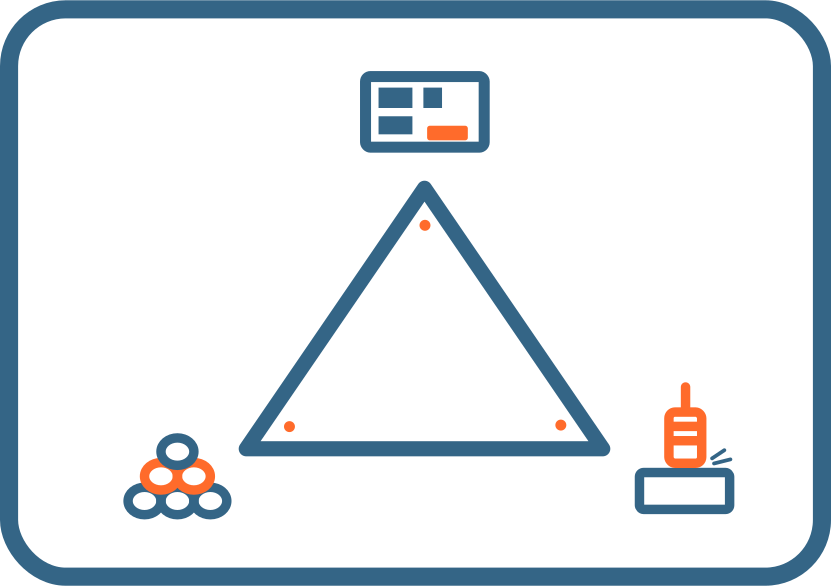
Three factors determine whether your design succeeds or fails: material choice, manufacturing process, and design features. They're inseparable. Change one, and the other two must follow. Material determines possible processes. Process determines design constraints. Design requirements dictate material and process. Pull one thread, and the whole fabric shifts.
- Why can't you choose a manufacturing process without first choosing a material?
- How does the Material–Process–Design triangle work in real product decisions?
- How did Tesla's decision to use giga-castings change the entire design approach?
- What framework should you use when evaluating material and process options?
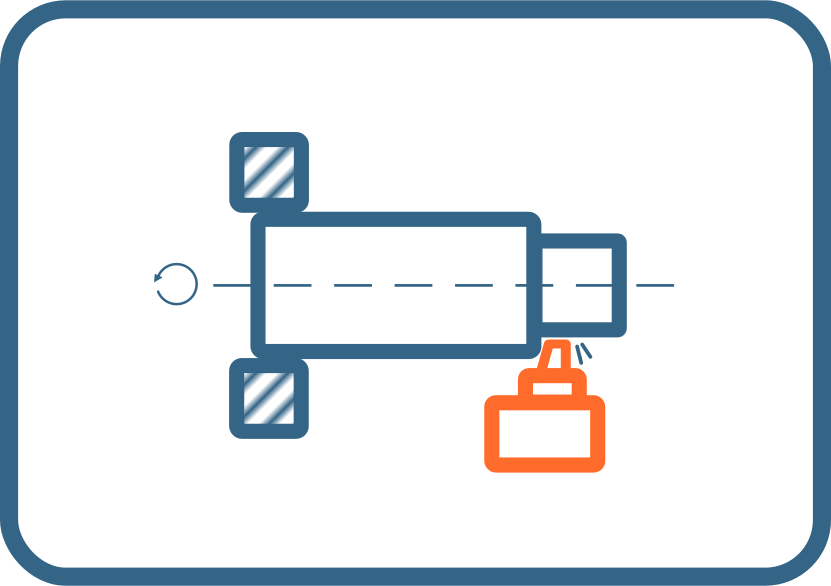
Machining is subtractive manufacturing — you start with raw material and remove material until you have the shape you need. Every feature is a cutting operation that requires time and tooling. When you design for machining, you're always thinking: every feature requires a tool to reach it, every surface must be accessible. Ask yourself — how will the machinist cut this?
- When should you choose CNC machining over conventional manual machining?
- Why can't you machine a sharp internal corner — and what should you do instead?
- What are the design rules that prevent expensive rework and tool breakage?
- How do you choose between machining and other processes for your part?

A colleague sent me a sheet metal file to modify. I added two holes, sent it to the shop. Two days later, the machinist came to my desk: "These dimensions are wrong. Did you check the K-factor?" I didn't. K-factor was 0.5 — the software default — wrong for 2mm stainless steel. Twenty parts would have been scrap. I'd trusted the software. He knew the reality.
- What is K-factor, why does the CAD default get it wrong, and how do you find the right value?
- Why does bend sequence matter — and how does it affect what geometries are possible?
- What are the minimum flange lengths, hole-to-bend distances, and bend relief rules?
- What information does your fabricator actually need from you to quote and build the part?
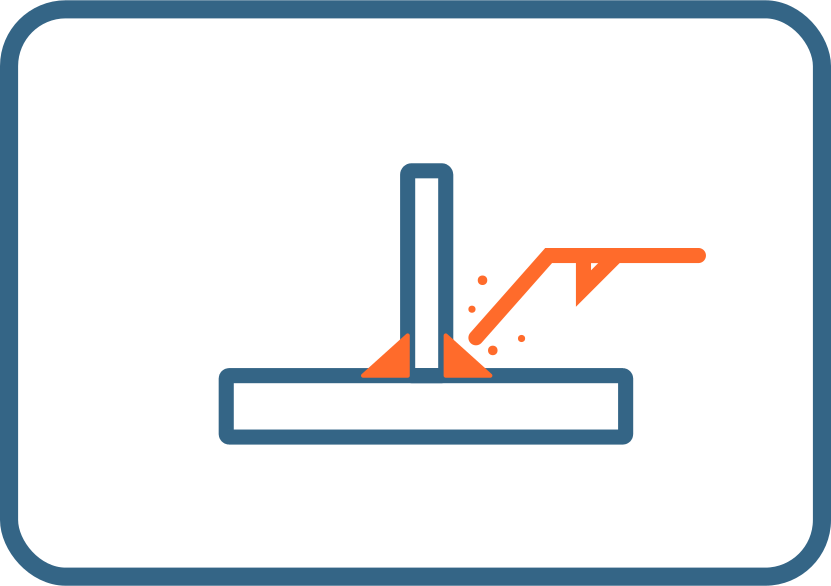
Welding shows up on almost every mechanical design project — structural frames, sheet metal enclosures, tube assemblies. But there's a difference between what looks easy in CAD and what happens in the shop. Compound-angle tube cuts needing extra setups, continuous welds on thin sheets that warp badly, or joints that welders simply cannot reach. These issues happen often and add real cost.
- When should you bend a tube versus cut and weld it — and what drives the cost difference?
- How do you design weld joints that a fabricator can actually access with a torch?
- What causes weld distortion, and how do you control it through design choices?
- How do you properly specify welds on engineering drawings?

Casting creates geometries impossible with other processes — internal cooling passages in turbine blades, engine blocks with integrated water jackets, pump housings with complex flow paths. All formed in one piece during solidification. The practical workflow is catalogue first, custom last. Search industrial catalogues, pick options that might work, then adapt your design to fit.
- What are the differences between sand, investment, die, and permanent mold casting?
- Why should you default to catalogue cast parts — and when does custom casting make sense?
- What are the critical design rules for wall thickness, draft angles, and fillet radii?
- At what volume threshold does custom casting become cheaper than catalogue parts?
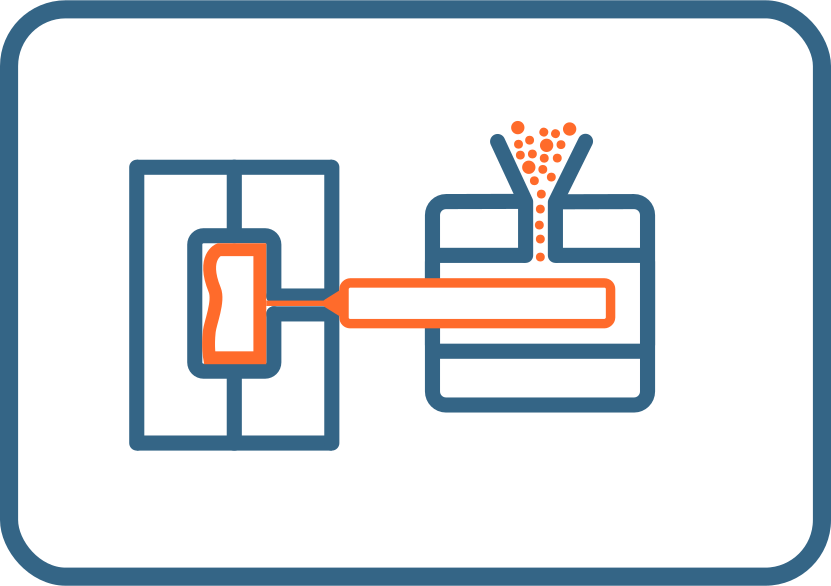
The economics are compelling — complex geometry with integrated features, produced consistently at high volume, at a fraction of what machining would cost. A vacuum cleaner housing with ribs, bosses, snap features, and mounting points comes out of the mold ready to assemble. But plastic manufacturing has its own rules. Wall thickness, draft angles, shrinkage, flow paths — these aren't optional. They're built into the physics.
- What's the real difference between thermoplastics and thermosets — and why does it matter?
- How do you design for uniform wall thickness and avoid sink marks, warping, and voids?
- When does injection molding make economic sense versus 3D printing or machining?
- What alternative plastic processes exist when injection molding isn't the right fit?

"We can just 3D print it" has become the modern equivalent of "we'll fix it in software." Sometimes true. Often dangerously naive. AM gives you geometric freedom that no other process can match. It does not give you free parts, fast parts, or parts with properties identical to conventionally manufactured components. The real question isn't "can we?" — it's "should we?"
- What are the real capabilities and limitations of FDM, SLA, SLS, and metal AM?
- How do you design specifically for additive — not just "print whatever CAD gives you"?
- What are the actual costs when you include post-processing, support removal, and finishing?
- When does 3D printing make engineering and economic sense versus traditional processes?

You've spent the previous chapters learning how things are actually made. Now comes the real engineering challenge: choosing. This chapter gives you universal DFM principles — design decisions that reduce cost and improve manufacturability regardless of process — and a systematic method for selecting between processes when multiple options could work.
- What DFM principles apply universally regardless of which manufacturing process you use?
- How do you systematically choose between machining, sheet metal, casting, and molding?
- How do you use selection matrices and flowcharts to justify your process decisions?
- What happens when plans change mid-project — how do you adapt your process choice?
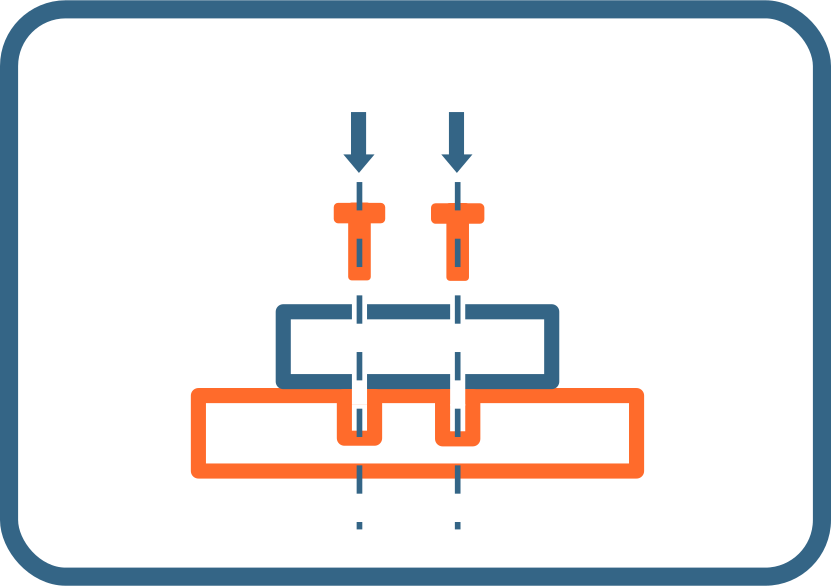
You've designed a beautiful part. Every dimension correct, every tolerance rational. Then someone has to put them all together, and everything falls apart. Here's a number that surprises most designers: assembly typically accounts for 40 to 60 percent of total product cost. Not material. Not machining. Assembly. The labor, the fixtures, the rework when something doesn't fit.
- Why does assembly cost 40–60% of total product cost — and how do you reduce that?
- How do you plan an assembly sequence before finalizing your design?
- What design choices reduce part count, eliminate fasteners, and prevent assembly errors?
- How do you design for maintenance and serviceability, not just initial assembly?
Glass, adhesives, seals, rubber profiles, fastener types, gas springs, sliders, locks, latches, levelling feet, handles. Components you'll specify in almost every design. Most engineering programs never mention them. Most BOMs are full of them. This chapter covers how to find them, select them, and design around them. Because when you're not manufacturing custom, these components drive your geometry.
- What do bolt grade markings mean and how do you identify them on sight?
- How do you choose between different nut types for a given application?
- What drives the selection of gas springs, and how do you size them?
- How do catalogue component dimensions constrain your design before you even start modelling?